Gate
6 days agoNews Editor

Gate data shows medical AI stocks in Japan and South Korea surged, with Lunit up 30% in 24 hours

Medical AI names in the Japanese and South Korean equity markets posted sharp gains on Oct. 26, according to market data cited by ChainCatcher from the Gate platform. Several concept stocks led intraday attention as the sector moved higher. Gate’s latest quotes showed Lunit (328130) hitting its daily limit and rising 30.00% over the past 24 hours. VUNO (338220) climbed 24.36%, while Neurofit (380550) gained 19.85%. The report said expectations for artificial intelligence applications in medical diagnosis picked up again as commercialization in medical AI accelerated and capital rotated back into the segment. The move put the healthcare AI theme at the center of market focus during the session.

270

Gate data shows medical AI stocks in Japan and South Korea surged, with Lunit up 30% in 24 hours
Microsoft
6 days agoNews Editor

Microsoft says its medical AI coordinator hit near-perfect results on complex cases

Microsoft researchers said in a study published Thursday in Science that a new AI system built to diagnose patients step by step performed far better than ordinary physicians on difficult rare cases. The tool, described as a "diagnostic orchestrator," is designed to mirror how a clinical team gathers information over time rather than making a one-shot judgment from a full set of records. According to the study, the system reached 100% accuracy on complex rare medical cases and delivered results at more than twice the accuracy of physicians using textbooks and the internet. Researchers also said AI-designed diagnostic pathways were more economical than those designed by human doctors, with the system adjusting the number of questions and tests under different budget limits to improve cost efficiency. Microsoft executive Harsha Nori said the team measured not only accuracy but also how carefully the system evaluated each case during the diagnostic process. Corporate Vice President Dr. Dominic King said the AI’s passing rate was close to 100%. Science also reported that, without budget constraints, a GPT-5-based orchestrator achieved 83.2% accuracy at an average cost of $5,431. Microsoft’s next phase will test the tool’s triage ability in the emergency department waiting area at Beth Israel Deaconess Medical Center in Boston.

210
Microsoft says its medical AI coordinator hit near-perfect results on complex cases
Google Research
10 days agoNews Editor

Google Research tests AI-assisted ultrasound system in U.S. and Kenya clinical settings

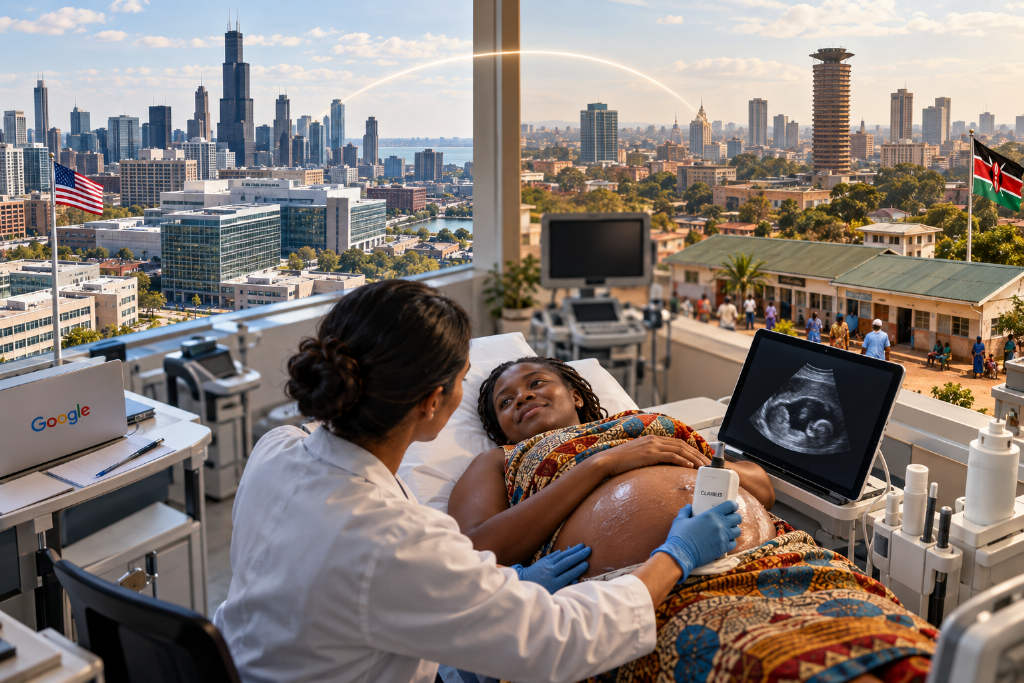
Google Research has published a study examining how an AI-assisted ultrasound system performs across different clinical environments. The system was originally trained on ultrasound data from North Carolina in the United States and Zambia, using commercial probes from Sonosite, GE, and Butterfly Networks. Researchers then paired the model with the Clarius C3 handheld transabdominal probe and ran prospective testing in two very different care settings: a high-resource academic medical center in Chicago and a community clinic network in Nairobi, Kenya. The study used a small pilot dataset from 120 participants in Chicago, roughly 6% of the original training set, to adapt the model to the new probe hardware and extend gestational age prediction beyond 36 weeks. To test generalizability, the team did not use data from the Nairobi site for fine-tuning, keeping the Kenya validation fully independent. The research also included multiple-gestation pregnancies to assess how the system performs in more complex cases.

510
Google Research tests AI-assisted ultrasound system in U.S. and Kenya clinical settings
Google
23 days agoNews Editor

Google’s AMIE study appears in The Lancet, with trial pointing to gains in doctor-patient interactions

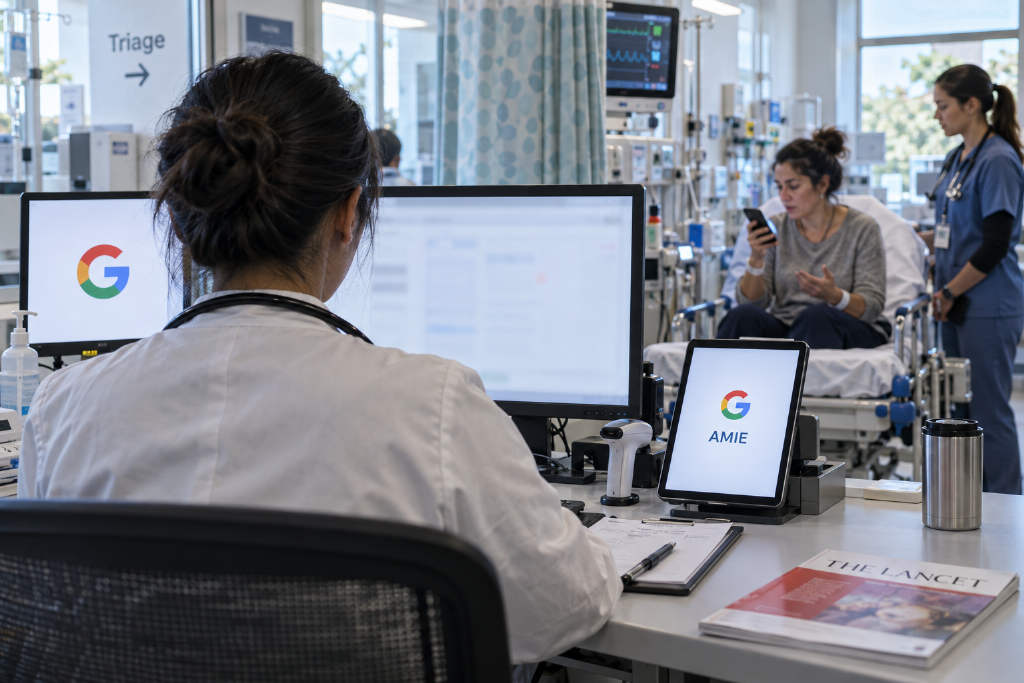
Researchers from Google and Beth Israel Deaconess Medical Center published a study on the diagnostic AI chatbot AMIE in the main journal of The Lancet, marking the first time Google research has appeared there, according to the source material. In the study, 98 patients used AMIE before emergency department visits in a real clinical setting, while physicians monitored the interactions in real time and the conversations continued without interruption. Clinicians said AI-generated summaries helped them prepare for patient visits in 75% of scenarios. In more than half of the cases, AMIE’s output changed the physicians’ diagnostic thinking. The study also found that the chatbot’s differential diagnoses matched physicians’ final diagnoses 90% of the time. The reported findings suggest AI may help improve doctor-patient relationships and ease pressure on medical staff.

550
Google’s AMIE study appears in The Lancet, with trial pointing to gains in doctor-patient interactions
University of Bristol
2 months agoNews Editor

University of Bristol researchers propose medical AI safety framework modeled on drug approval

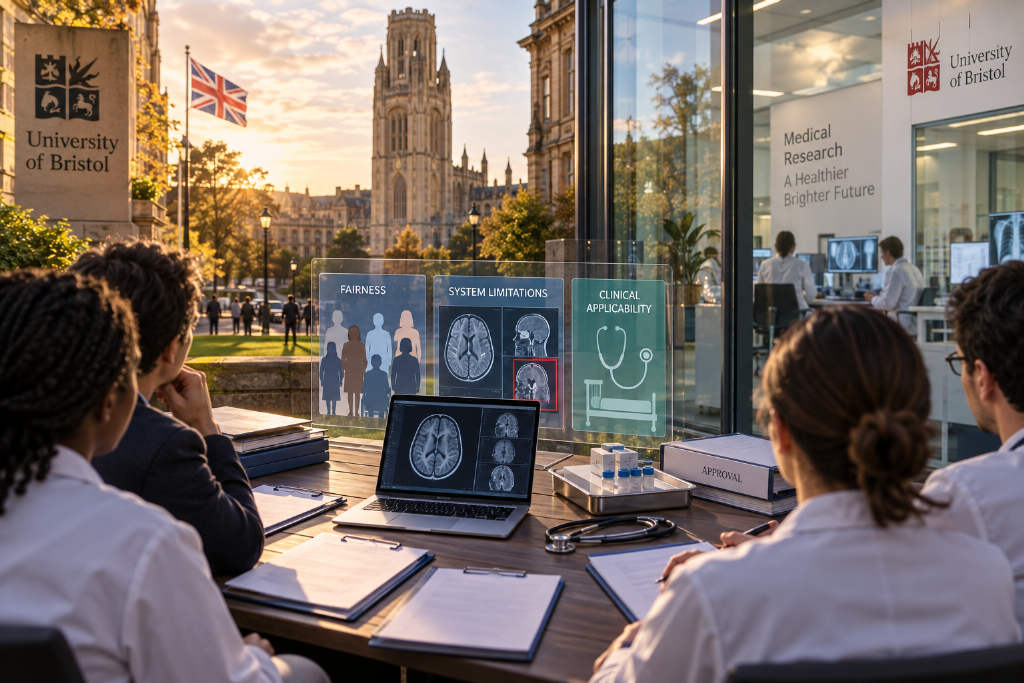
Researchers at the University of Bristol have proposed a medical AI safety framework called "Learning Ensemble," according to Techub News, citing The Decoder. The framework is designed to make medical AI systems safer by borrowing from the logic of drug approval processes rather than relying only on technical feasibility. It sets out three areas for review: system limitations, fairness across patient groups, and clinical applicability. The stated goal is to identify models that may appear technically workable but could still produce dangerous errors in real clinical settings. The proposal focuses on screening for risks that might not be obvious from performance alone, especially when a model is moved into healthcare use. No additional implementation details were disclosed in the brief report.

630
University of Bristol researchers propose medical AI safety framework modeled on drug approval
Ant Bailing
2 months agoNews Editor

Ant Bailing Launches Medical AI Model Sante: 5.1B Active Parameters, Outperforms GPT-5.6 Sol in Diagnosis

Ant Bailing has launched Ling-3.0-flash-Sante, a medical AI model using MoE architecture with 124 billion total parameters and only 5.1 billion active per token. In benchmarks, Sante achieved 83.8 on DiagnosisArena-MCQ, surpassing GPT-5.6 Sol (81.9), Kimi K3 (78.4), and Gemini 3.6 Flash (76.2). On MedXpertQA-Text, it scored 53.9, slightly above Kimi K3 but below GPT-5.6 Sol and Gemini 3.6 Flash. The model also performed well on BrowseComp, DeepSearchQA, and HLE with tools, emphasizing self-research and answer generation. For medical ethics, Sante scored 82.1 on MedEthicAlign and 78.6 on the internal safety test AFUSAFE-MedSCE. It is now freely accessible via OpenRouter and Vercel.

1550
Ant Bailing Launches Medical AI Model Sante: 5.1B Active Parameters, Outperforms GPT-5.6 Sol in Diagnosis
Google Research
3 months agoNews Editor

Google Research unveils GlucoFM, a 720,000-parameter foundation model for glucose monitoring

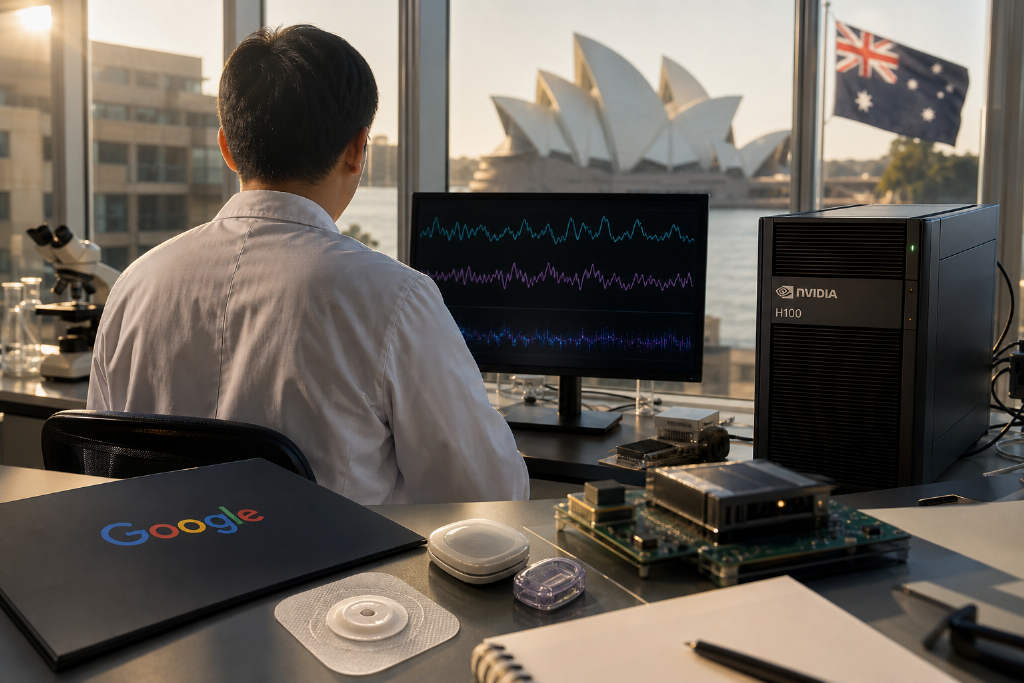
Google Research and the University of New South Wales in Sydney have introduced GlucoFM, a self-supervised foundation model built for continuous glucose monitoring. The model processes glucose signals through a dual-stream setup that separates slower physiological "state" signals from transient "event" signals. According to the release, GlucoFM has just 720,000 parameters and was pretrained on a single NVIDIA H100 GPU, pointing to a relatively lightweight training footprint compared with larger deep learning systems. In evaluations spanning 14 cohort-task settings, the model posted an average PR-AUC of 58.8 and outperformed baseline models. The research team said GlucoFM remains a research prototype and has not been cleared by any regulator. It is not intended for disease diagnosis or treatment. The team also said it plans to release the code and reproduction scripts, allowing groups with glucose monitoring datasets to run inference on CPUs or on-device systems using the same approach. Techub cited MarkTechPost as the source for the update.

1370
Google Research unveils GlucoFM, a 720,000-parameter foundation model for glucose monitoring
Total 13 items
Go topage